
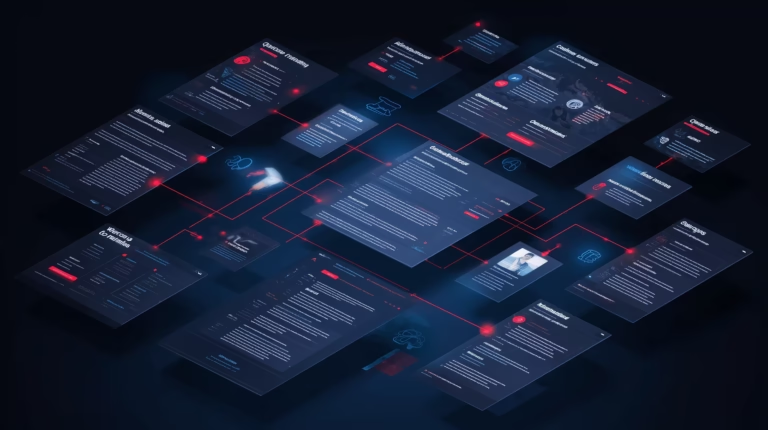
The content and structure of a website are among the most important aspects to consider before creating or updating a website. If the structure is unclear, the text tends to become repetitive. If the text isn’t properly prepared, the design becomes nothing more than attractive blocks of text without a clear message. But when both elements are in harmony, visitors understand the offer more quickly and are more likely to move towards a decision.
The question remains the same. What to put on the website and how to organise that information. The answer depends on the purpose, the services, the audience and the questions people have before getting in touch.
The structure begins with people’s questions
The structure of a website should not be based solely on how the business sees itself from the inside. What matters more to the visitor is what they want to understand: price, process, differences between services, examples, and trust. The article provides more detailed information on planning the structure how to plan a website structure.
The structure of the pages should help users find the answer, rather than displaying everything at once. If the menu is too long, users start making choices based on guesswork rather than their actual needs. This makes even good content harder to access.
Content must have a clear purpose
A content strategy is not just a list of articles. It is a plan for what a person needs to understand at each stage. One piece of text helps them get acquainted, another helps them compare, and a third helps them prepare for a conversation. This is discussed in more detail in the article Content strategy for the new website.
A table of contents helps to avoid random pages. If each page has a specific purpose, the text becomes shorter, clearer and more useful. There’s no need to include everything on the home page. It’s better to direct the reader to where they’ll find a more precise answer.
- The home page explains the direction
- service pages respond to specific needs
- The prices page reduces uncertainty
- The articles address the questions that arise before a decision is made
The user journey must be logical
The user journey shows what a person sees first, what they read next, and when they are ready to take action. It is important that the user does not get stuck. If they read about the price, it makes sense to offer them information on preparation. If they read about the structure, they may need a list of pages or a table of contents.
It is therefore useful to have internal links between related texts. For example, an article about necessary website pages should be related to the structure, and the text about preparing content for the website should lead to a content strategy.
How to start planning without a large-scale system
There’s no need to create a complex document straight away. Start with a simple list. What services need to be presented? What questions do customers ask most often? What solutions are people comparing? What information do they need before getting in touch? This list will very quickly show you what pages and articles you need.
- Please list the main services
- Add the most frequently asked questions to each service
- distinguish between the information that needs to be on the page and the topic of the article
- Please check where an internal link to another answer is required
If you are designing the structure of your website, you can find more information in the article How do you plan the structure of a website?. If you want to complete the plan properly, it is also worth reading Content strategy for the new website.
How to distinguish a page from an article
One practical question is very helpful when planning. Should this information be permanently visible as part of the service, or does it primarily answer a single specific question? If users need to be aware of the service at all times, it should be a page. If the topic explains a detail, helps with comparisons or aids preparation, it is usually better suited to an article.
For example, „website development“ is a service page. „How much does a website cost?“ is an article, because people are looking for an explanation. „How to prepare content for a website“This is also an article, as it helps you prepare. This approach means you don’t have to cram everything onto one long page.”.
- Service information is displayed on the page
- Answers to questions often turn into articles
- comparisons are suitable for a blog
- The pricing structure can apply to both a webpage and an article, provided the topics are different
A content plan should be helpful to both the developer and the client
A content plan is not just an SEO document. It helps you understand what information is missing before you start designing. If there are no service descriptions, the design will be created based on guesswork. If there are no pricing logic, it is harder to build trust. If there are no answers to frequently asked questions, the website will leave too much room for uncertainty.
When the content strategy is prepared in advance, the creation process itself becomes smoother. The design can be based on actual text rather than placeholder text. Pages have a clear purpose. Internal links emerge naturally, as it is already clear which topics complement one another.
- number the pages
- Add a description of the purpose of each page
- Please indicate which texts are still missing
- Please identify which articles will answer the additional questions
When the structure is already too complex
A structure becomes too complex when a person has to think about where to look for an answer. There are too many menu items, pages with similar names, and several pieces of text on the same topic, but none of them provide a complete answer. In such cases, the page structure does not help, but rather complicates matters.
Simplicity is a good sign. If a visitor can work out within a few seconds where to find the service, an explanation of prices, examples and the call to action, the structure is already working. If you have to explain over the phone where things are on the website, it’s worth having a look at it.
If you would like to organise your website’s content and structure in a way that is clear to visitors, please get in touch. We can review the existing information and draw up a simple, realistic plan.